TWO:John Gay, a contemporary of Pope, Swift, and Arbuthnot, is now best known by his "Fables" and his "Beggar's Opera." His "Fables" have been extremely popular, and still make him a general name; but, in his own time, his "Beggar's Opera" was his great success. Its wit, its charming music, its popular characters, gave it a universal favour; and it is the only English opera that even to this time has become permanent. Gay's "Trivia; or, the Art of Walking the Streets of London," is still amusing, and some of his ballads have a lightness and buoyancy about them which justify the esteem in which he was held.
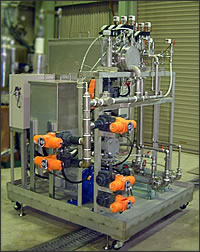
A hydrocyclone (liquid cyclone) injects treatment solution into stationary equipment to perform separation, classification, and concentration, and is an innovative separator with a very simple structure and no drive unit.
Structure of a hydrocyclone (liquid cyclone)
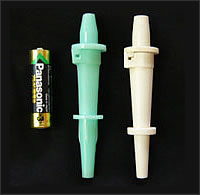
A suspension containing fine particles of several micrometers or more is supplied to a cylindrical container circumferentially at high speed. And as a result it starts to rotate and a centrifugal force is generated. At this time a gravitational acceleration of several tens of thousands of G is generated in the circumferential direction, and thus leading to fast sedimentation and concentration of the fine particles. The separated concentration can be freely selected by changing the supply rate (supply pressure and flow rate) and the flow ratio of the outlet. Our hydrocyclone (liquid cyclone) was designed and manufactured to classify and concentrate fine particles, and so has a small element.
THREE:But long before this¡ªas early, indeed, as the 15th of April¡ªnews had reached London of the death of the erratic Emperor Paul, and of the bombardment of Copenhagen by the British fleet. Paul had been won over by Buonaparte to his views, and had been flattered by him by being elected¡ªthough irregularly and illegally¡ªGrand-Master of the Knights of Malta. He had been persuaded that the conquest of Malta by the British was an invasion of his rights, and by these and other flatteries Buonaparte had influenced his weak mind to become the agent of his plans in destroying the British ships in the Baltic, and in closing that sea to British commerce. Paul pretended that we had captured Danish convoys, these same convoys being engaged in guarding vessels loaded with materials of war for France, and that thus the independence of the North was menaced by us. On this ground, and on that of the invasion of Malta, he immediately laid an embargo on all British vessels in Russian ports, and as two vessels in the harbour of Narva resisted the attempts to seize them, in consequence of the embargo, he ordered all the British vessels in that port to be burned. In consequence of this sudden and unwarrantable order, contrary to all the laws of nations, about three hundred British vessels were seized, and the officers and crews dragged on shore, put into irons, and sent up the country under menaces of Siberia. Paul next ordered all property of Englishmen in Russia to be seized and sold. Denmark¡ªwith whom we had various rencontres, on account of its men-of-war convoying vessels laden with stores for French ports¡ªsoon joined Russia. We sent Lord Whitworth to Copenhagen to endeavour to come to some understanding on these matters in 1800, but though a convention was signed, it was not satisfactory. Sweden followed the example of Denmark, and the three Northern Powers entered into a treaty of armed neutrality to resist our search of their vessels in any circumstances. As the consequence of this policy would be to shut us out of all trade with the ports of the Baltic, it was resolved to send a fleet to chastise these Powers and break up their co-operation with France. Mr. Vansittart was despatched to Copenhagen, accompanied by a fleet of eighteen sail of the line, with several frigates and smaller vessels, under command of Admiral Sir Hyde Parker, with Vice-Admiral Nelson as second. The fleet left the Yarmouth Roads on the 12th of March, 1801, and arriving at the mouth of the Sound, Nelson recommended that they should sail directly up to Copenhagen, and be prepared, on the refusal of our proposals, to bombard the place, as this would not allow them time to get ready their batteries, and thus do all the more damage to our ships and men. But this was deemed too offensive before any attempt at negotiation, and accordingly Mr. Vansittart was sent forward in a frigate with a flag of truce, leaving the fleet at the Scaw. He returned without effecting anything more than what Nelson anticipated. Sir Hyde Parker wasted time in making[481] the needless inquiry by a flag of truce of the Governor of Elsinore, whether the passage of the Sound would be disputed, who replied that it would. It was then proposed to enter by the Belt. Nelson said:¡ª"Let it be by the Sound, or the Belt, or anyhow¡ªonly don't let us lose an hour."It was a strong door, built of great thick boards and barred with iron, but it must surely cede before fire and the blows. It wrenched on its huge hinges.
- Equipment costs can be reduced.
- Operating costs can be reduced.
- Maintenance costs can be reduced.
- Any change in raw material and product can be easily addressed.
- Large amounts can be treated in a small area.
- Separation and cleaning are easy because of the simple structure.
- Simplified control
- This equipment can be operated in synchronization with external devices.
- Alarm and interlock mechanism.
THREE:She was still silent, but she leaned nearer, watching his face, her lips drawn away from her sharp teeth, and her eyes narrowing. She understood now.
- Classification and concentration for the manufacture of inorganic powder materials
- Classification of ceramic materials
- Removal of fine particles, including iron powder
- Removal of fine particles from pigments
- Removal of fine organic particles from solvents
- Separation of starch and yeast
- Removal of fine particles from high-temperature strong acid solutions
- Removal of fine particles from low-temperature solutions